Storyselling ≠ storytelling
By Ida Josefiina
Storyselling
In recent years, talk around “storytelling” in brand worlds has grown significantly. We see people using the term as a job title, a function, or a nicer word for posting on social media (no shade). The meaning changes depending on who’s saying it and within what context, and this imprecision only further contributes to the confusing soup that is brand communications.
Companies have gotten the memo that “story” and “taste” are important, and brands have rushed off to the races. But this well-minded intention hasn’t actually produced meaningfully more great stories. If anything, brands have never sounded more alike.
In The Crisis of Narration, Byung-Chul Han argues that this itself is a symptom that we’ve lost real narration, and storytelling has become storyselling. Story is used as a sales technique, a way to wrap a product in feeling so it’s easier to swallow. This happens when a brand starts with a message (we’re fast, we’re secure, we care about X), and then proceed to build a “story” to carry that message, making narrative just the packaging for a pitch. This way of working produces artifacts you may be all too familiar with. Think: launch videos that vaguely explain a problem, introduce a mission, then go off to show the product with flashy motion graphics, often featuring the founder sitting on a beige sofa (sigh).
The way to effective communications
Telling real stories is not all that complicated, but it’s not particularly easy either. It’s not complicated because it simply demands that storytelling is thought of as the foundation of effective communications, rather than a vehicle for a message. But it’s not easy because it requires going back to the source.
Every company starts from a founder(s)’ lived experience. Their ideas, references, memories, and the odd connections that led them to build this thing instead of something else. Over time, all of that gets compressed into a message that is far flatter than the original story. That message can be sharp, and an effective tool for pieces of a brand’s communications strategy, but it should not be the starting point for creating the narrative foundation.
Storytelling is the work of recovering the source material and pulling the narrative threads from it. Doing it this way guarantees that what you have to say is truly yours, and makes it impossible to compete with because no one else can be you. And when that story gets disseminated across campaigns, channels, keynotes, pitches, films, and activations it will have spine, legibility, and authenticity behind it.
Storytelling, marketing, social media
In summary: storytelling shall not be confused with marketing, brand, or social media. If it is treated as an afterthought of marketing, you usually end up making content around a predetermined message. If storytelling is treated as its own discipline, you can uncover stronger ideas, choose better formats, build worlds, create recurring characters or series, and make artifacts people actually want to engage with.
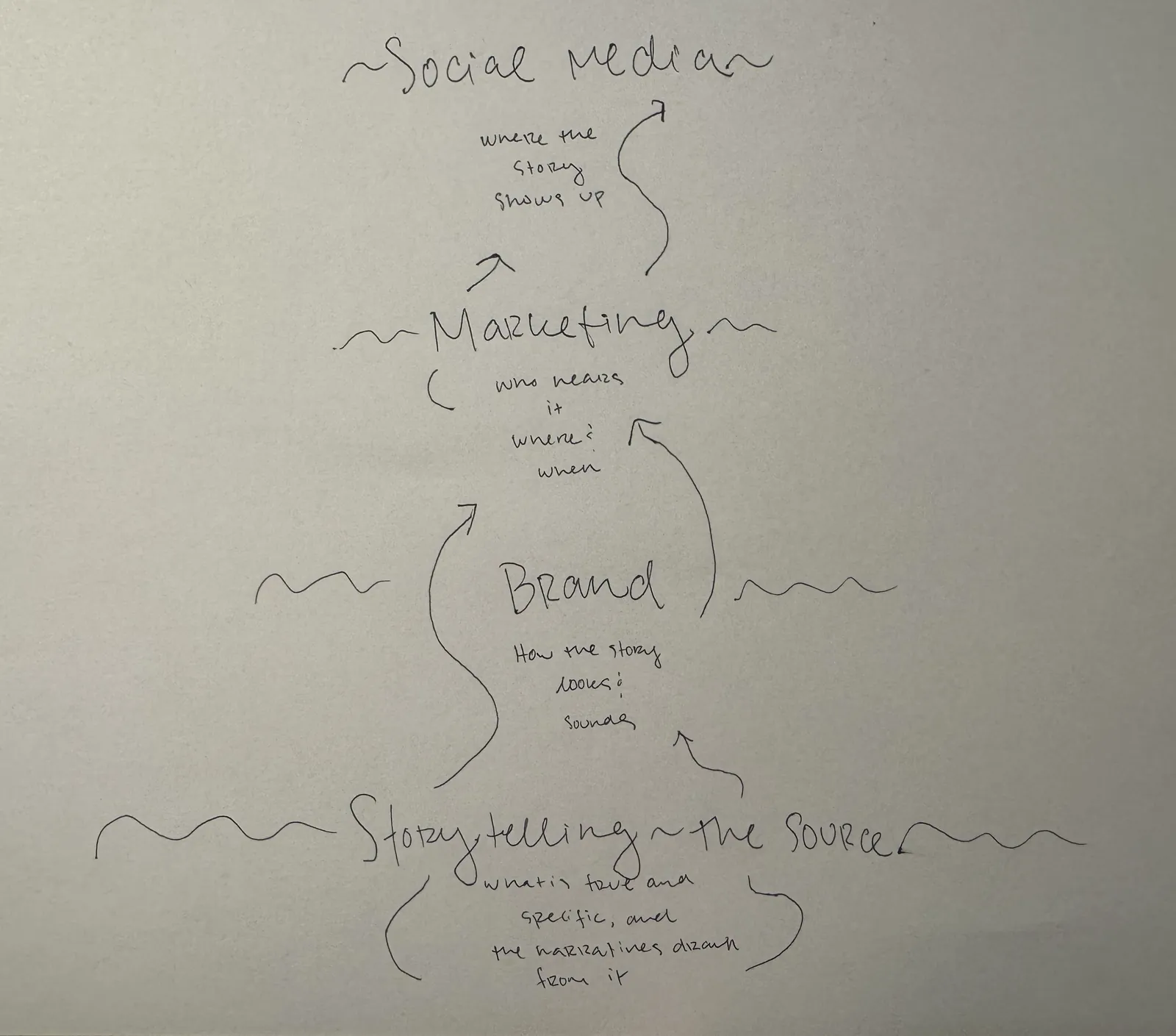
An interesting parallel for this phenomenon is to look at the evolution of design over the last few decades. Design used to be the thing you’d do at the end to “make it look nice.” Then companies like Airbnb (or Apple way back) showed it could be foundational, and it became a strategic function that shaped the product and the company from the start. Rather than working on top of decisions made by engineers, design started informing what got made in the first place.
Storytelling is at the same inflection point. Right now, it’s mostly the wrapper around everything else. But what would it look like if story was thought of as the foundation? Perhaps the billboards in San Francisco would start telling us something beyond “the AI agent for X”.